


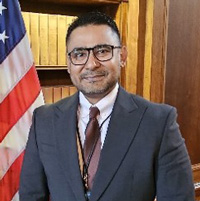
 Shariq Ashfaq
Shariq Ashfaq serves as a supervisor at the Institute for Telecommunication Sciences (ITS), part of the NTIA within the U.S. Department of Commerce. He leads and participates in research programs, budgets, and staff development, working with inter-government stakeholders, industry, academia, and international partners on advanced wireless technologies. At ITS, he directed development of the 5G RAN testbed and has been part of research initiatives such as the ITS 5G Challenge, the RIC Forum, and the International Open RAN Symposium. He is the lead NTIA delegate for RAN TSG & Workgroups in 3GPP and the O-RAN ALLIANCE, contributing to the development of 6G work, Open RAN, spectrum management and sharing, NTN, ISAC & public safety. Previously, Mr. Ashfaq held leadership roles at AT&T and Verizon, managing large LTE/5G deployments and $20M+ annual capital programs, and at DISH Wireless, where he led deployment of he United States’ first cloud-native, Open RAN–based 5G standalone network in the south central region of Texas. He holds a BEng in electronics from the N.E.D. University of Engineering & Technology and an MS in electrical and computer engineering, Wichita State University, Kansas.
 Prasanth Ananth
Prasanth Ananth heads the RAN Platforms Research department at Nokia Bell Labs. He leads a multidisciplinary team that conducts applied research and prototyping for wireless sensing, AI-RAN, and energy efficiency. Previously, he set up and led the Aerial Robotics research team, developing autonomous indoor drones with edge intelligence, and founded the Nokia Autonomous Inventory Monitoring Service (AIMS) venture, for which he served as the CTO. Prior to that, he led research on access networks and chaired global working groups in the Open Gen 5G UAS and GreenTouch consortiums. A PhD graduate from the University of Maryland with a postdoc at the University of Texas at Austin, Prasanth holds several patents and has authored several publications. He is recognized as a Nokia Distinguished Member of Technical Staff (DMTS).
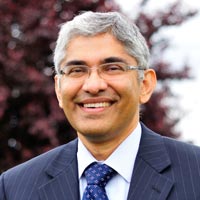 Kumar Balachandran
Kumar Balachandran is a Senior Expert in Radio Concepts and Spectrum Technologies at Ericsson Research. Before joining Ericsson, he worked at Pacific Communication Sciences Inc., a Cirrus Logic subsidiary, where he contributed to systems engineering and specification work for the Cellular Digital Packet Data (CDPD) system, an early digital cellular standard compatible with the North American Cellular System. Over 31 years at Ericsson, he has worked across every generation of cellular standards, first on mobile terminals and later on infrastructure, with a focus on signal processing and systems algorithm design. He holds a doctorate in computer and systems engineering from Rensselaer Polytechnic Institute. His early Ericsson work included a GSM-based satellite telephone system specified for ACeS, a geostationary service for Indonesia. He represented Ericsson at ITU-R during part of the IMT-2000 qualification process, contributed to Citizens Broadband Radio Service (CBRS) specification activity, and has long worked on spectrum-sharing studies, including 5G spectrum sharing with radar systems. His 5G work addressed physical layer security and radio resilience. He is active in Ericsson’s outreach to regulators including the FCC, ISED, and Ofcom, providing technical analysis and justifications for spectrum regulations. He has served for many years on the FCC Technological Advisory Council and participates actively in the NextG Alliance to help define North American priorities for 6G. His current 6G work continues to address radio resilience and spectrum. He is named on over 110 US patents, is well published, and has contributed to several books.
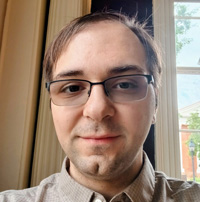 Robert Ballard
Robert Ballard received a BS degree in computer science from the University of Colorado Boulder in 2018. He joined the Institute for Telecommunication Sciences in 2014, and today works as a Computer Scientist and Project Manager at the lab. He has acted in a variety of roles while at ITS, including contributing to the Spectrum Characterization and Occupancy Sensing platform, the Propagation Modeling Website, and the laboratory’s Open Science initiatives. At ITS, Ballard leads research on applying artificial intelligence/machine learning (AI/ML) techniques in spectrum, data engineering against wireless datasets, and application development across multiple ITS-driven platforms. His technical interests include AI/ML model development, data engineering and the construction of novel and meaningful datasets, and cross-disciplinary collaboration.
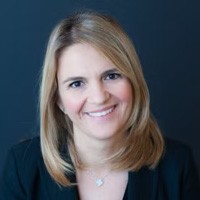 Danijela Čabrić
Danijela Čabrić is a Professor in the Electrical and Computer Engineering Department at the University of California, Los Angeles. She received the MS from the University of California, Los Angeles, in 2001 and the PhD from the University of California, Berkeley, in 2007, both in Electrical Engineering. In 2008, she joined UCLA as an Assistant Professor, where she heads the Cognitive Reconfigurable Embedded Systems lab. Her current research projects include novel radio architectures, signal processing, communications, machine learning and networking techniques for spectrum sharing, millimeter-wave, massive MIMO, and IoT systems. She served as a principal investigator in the three large cross-disciplinary multi-university centers, including SRC/JUMP ComSenTer and CONIX, and NSF SpectrumX. Prof. Čabrić was a recipient of the Samueli Fellowship in 2008, the Okawa Foundation Research Grant in 2009, the Hellman Fellowship in 2012, the National Science Foundation Faculty Early Career Development (CAREER) Award, also in 2012, and the Qualcomm Faculty Award in both 2020 and 2021. She is an IEEE Fellow.
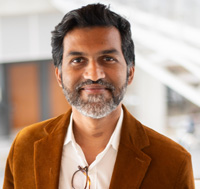 Kaushik Chowdhury
Kaushik Chowdhury holds the Chandra Family Endowed Distinguished Professorship in Electrical and Computer Engineering #2 at The University of Texas at Austin, where he is a member of the Wireless Networking and Communications Group (WNCG). He earned his MS from the University of Cincinnati and his PhD from the Georgia Institute of Technology. Prior to joining UT Austin, he served for 15 years as a professor at Northeastern University in Boston, Massachusetts. His research spans applied machine learning for wireless systems, including deep learning for spectrum sensing and sharing, RF cybersecurity, multimodal sensor fusion and digital twins. He is a Fellow of the IEEE. His work has been recognized with major honors, including being a finalist for the 2023 U.S. Blavatnik National Awards for Young Scientists, the U.S. Presidential Early Career Award for Scientists and Engineers (PECASE), the DARPA Young Faculty Award, the ONR Director of Research Early Career Award, and the NSF CAREER Award.
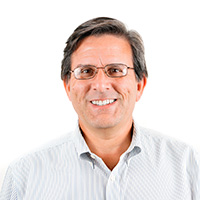 Andrew Clegg
Andrew Clegg is a co-founder of Valo Analytica, a start-up dedicated to radio spectrum data and analytics. He also holds a part-time appointment as senior research scientist in Baylor University’s Electrical and Computer Engineering department and is a member of the Baylor-led SMART Hub collaboration. He is the CTO of the Wireless Innovation Forum, where he chairs the AI and Highly Dynamic Spectrum Sharing working groups. Previously he served as spectrum engineering lead for Google, where he was a prolific contributor to the FCC’s proceeding establishing CBRS. After adoption of the final CBRS rules, he served as chair of the Wireless Innovation Forum committee that created the industry standards on which the CBRS ecosystem runs. He helped design, build, certify, and operate the Google SAS and its related ESC network. He was also the world’s first CBRS Certified Professional Installer. Prior appointments include electromagnetic spectrum manager for the National Science Foundation, lead member of technical staff for Cingular Wireless (now part of AT&T), senior engineer at Comsearch, and research scientist at the Naval Research Laboratory. He holds a PhD in radio astronomy and electrical engineering (minor) from Cornell University. He is also an extra-class amateur radio operator, FCC call sign W4JE.
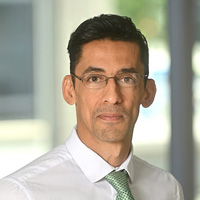 Aloizio Da Silva
Dr. Aloizio Da Silva serves as a CCI xG Testbed director at Commonwealth Cyber Initiative (CCI) and Research Faculty at Electrical and Computer Engineering (ECE) Department at Virginia Tech. Dr. DaSilva currently leads the Washington, D.C., metro area O-RAN Open Testing Integration Center (OTIC). Da Silva’s areas of interest include wireless network, 5G and beyond, software defined networks (SDN), software defined radio (SDR), network function virtualization (NFV), AI applied in wireless network, AI-RAN, large-scale testbed experimentation, and mobile edge computing (MEC). He currents leads the NTIA NOFO I ACCoRD Project at Virginia Tech in partnership with AT&T and Verizon and the AI-RAN OCUDU MU-MIMO Project with Softbank. Da Silva is also Technical Project Manager for Platforms for Advanced Wireless Research (PAWR) program at US-IGNITE/NSF PAWR PPO where he manages and oversees PAWR testbeds, including AERPAW, POWDER, COSMOS, ARA and HUDINI. His background includes deep-space communication intersecting with delay and disruption tolerant networks (DTNs). Da Silva has experience on European Horizon projects acquired during his role as 5G portfolio manager and research fellow at University of Bristol UK. Da Silva earned his BS degree in computer science from the Pontificia Universidade Católica de Minas Gerais, Master of Science (MSc) in computer science from the Universidade Federal de Minas Gerais (UFMG), Master of Business Administration (MBA) in project management from the Fundação Getúlio Vargas (FGV) and Babson Executive College, and doctorate (Ph.D) in computer engineering from the Instituto Tecnológico de Aeronáutica (ITA).
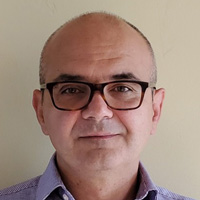 Aleksandar Damnjanovic
Aleksandar Damnjanovic is a 6G Spectrum Research Lead with Qualcomm Wireless Research and brings more than 25 years of professional experience working on research, development, prototyping and standardization of cellular technologies (i.e., 3G, 4G, 5G, and now 6G) Wi-Fi and UWB. He is a holder of more than 650 U.S.–granted patents with more than 2,100 external citations in the field of wireless communications. His research interests include interference management, medium access, shared spectrum, network MIMO, private and relay networks, cooperative communications, jamming resilience, digital twin, AI-RAN, NTN, and ISAC for spectrum bands targeted for 6G deployments. Dr. Damnjanovic holds a ScD degree in Electrical Engineering from The George Washington University.
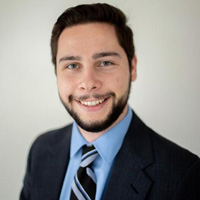 Ryan Dreifuerst
Ryan Dreifuerst is the Computational Signal and Spectrum Analysis Group Leader at The MITRE Corporation. His work primarily focuses on the areas of propagation modeling, digital twins for signal modeling, and AI for RF contexts. He currently leads research projects on digital twin development for spectrum coexistence, network optimization, and RF foundation model development. Prior to working at MITRE, Mr. Dreifuerst received dual BS degrees from Milwaukee School of Engineering and Technische Hochschule Luebeck, the MS degree from The University of Texas at Austin, and the PhD degree from North Carolina State University. Mr. Dreifuerst’s research under the supervision of Prof. Robert Heath investigated domain-specific AI for massive MIMO codebook design. In the past, Mr. Dreifuerst has worked with industry partners on 5G and 6G R&D through internships with Meta, Qualcomm, Samsung Research America, and Nvidia).
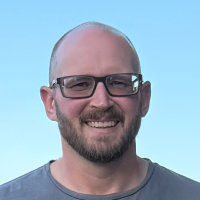 Bradley Eales
Bradley Eales is a data scientist and project manager at the National Telecommunications and Information Administration's Institute for Telecommunication Sciences (NTIA-ITS), where he drives federal spectrum research through advanced analytics, infrastructure development, and technical leadership. With over 25 years of experience in signal and data analysis, his work centers on applying AI/ML techniques to dynamic spectrum coexistence, aggregate interference analysis, spectrum management, and clutter classification. Mr. Eales leads the ITS Data Science/AI/ML Working Group, where he has trained staff on AI/ML methodologies. He was a long-time contributor to the IEEE Spectrum Consumption and Occupancy Sensing (SCOS) standard, which defined the sensor communication architecture adopted by the NASCTN Spectrum Efficiency Assessment (SEA) system. He designed and built DevNet and served as a key architect of its successor, LabNet, the institute's secure research network. Mr. Eales holds dual MS degrees in geophysics and data science.
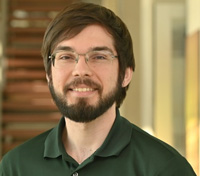 Austin Egbert
Austin Egbert received the BS degree in electrical and computer engineering from Baylor University, Waco, Texas, in 2017, and he received the MS and PhD degrees in electrical and computer engineering from Baylor University in 2021. He is currently a Research Assistant Professor with the Hub for Spectrum Management with Adaptive and Reconfigurable Technologies (SMART) at Baylor University, developing deployable solutions for modern spectrum issues involving real-time circuit optimization and dynamic spectrum allocation. Dr. Egbert is also a member of the Wireless Innovation Forum (WInnForum), where he is the author and maintainer of the 6 GHz Automated Frequency Coordination (AFC) System Under Test (SUT) test harness. He is also the co-chair of WInnForum’s 6 GHz AFC Authorized Test Lab (ATL) task group and received the WInnForum President’s Award in 2023.
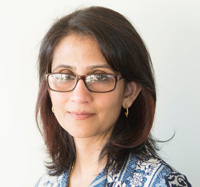 Monisha Ghosh
Monisha Ghosh is a Professor of Electrical Engineering at the University of Notre Dame. She is also the Policy Outreach Director for SpectrumX, the first NSF Center for Spectrum Innovation and the co-chair of the FCC’s Technological Advisory Council (TAC) Working Group on Advanced Spectrum Sharing. Her research interests are in the development of next generation wireless systems, with an emphasis on spectrum sharing and coexistence, and leveraging insights from extensive measurements of real-world network deployments, both cellular and Wi-Fi. Prior to joining the University of Notre Dame in 2022, she was the Chief Technology Officer at the Federal Communications Commission, a Program Director at the National Science Foundation, Research Professor at the University of Chicago and spent 24 years in industry research at Bell Labs, Philips Research and Interdigital working on a wide variety of wireless systems: HDTV, Wi-Fi, TV White Spaces and cellular. She obtained her BTech from IIT Kharagpur in 1986 and PhD from USC in 1991. She is a Fellow of the IEEE.
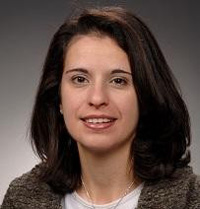 Nada Golmie
Nada Golmie received her Ph.D. in computer science from the University of Maryland at College Park. Since 1993, she has been a research engineer at the National Institute of Standards and Technology. From 2014 to 2022, she served as the chief for the Wireless Networks Division in the Communications Technology Laboratory. She is an IEEE and a NIST Fellow. Her research in media access control and protocols for wireless networks led to over 200 technical papers presented at professional conferences and journals, and contributed to international standard organizations and industry-led consortia. She is the author of Coexistence in Wireless Networks: Challenges and System-level Solutions in the Unlicensed Bands (Cambridge University Press, 2006). She leads several projects related to the modeling and evaluation of future generation wireless systems and protocols and serves as the NextG Channel Model Alliance chair.
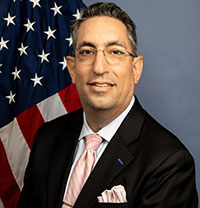 David Goldstein
David Goldstein serves as a NTIA Associate Administrator and the Director of ITS Director since September 23, 2024. Mr. Goldstein brings a wealth of experience in both the federal and commercial sectors, with more than 20 years of expertise in engineering, testing, simulation, and program management. Most recently, Mr. Goldstein served with the DoD, where he focused on addressing electromagnetic spectrum policy challenges, including supporting the DoD Chief Information Officer’s efforts in implementing the Electromagnetic Spectrum Superiority Strategy. Mr. Goldstein’s career spans notable roles in the private sector, including his time at Deloitte Advisory developing information battlespace risk common operating picture tools, spectrum investment strategies, and portfolio management. His early career includes distinguished service as a Navy Civilian with Naval Air Systems Command (NAVAIR). In this capacity, he supported rapid counter-IED project development and led complex testing and modeling activities. This included the installation and execution of a 3G/4G wireless network to support critical test executions. Mr. Goldstein is leading ITS in advancing critical innovation in communications and spectrum management technologies — a major national priority.
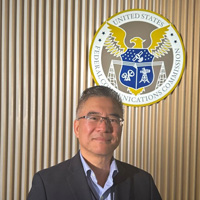 Michael Ha
Michael Ha is the Chief of Policy and Rules Division in the Office of Engineering and Technology at the Federal Communications Commission. Since joining the Commission in 2010, he has been engaged in various spectrum policy matters for wireless broadband services, mobile/fixed satellite services, public safety services and unlicensed services. Mr. Ha's recent focus has been on the identification of 800 MHz of spectrum for commercial use as required by the One Big Beautiful Act (OBBBA) of 2025. Michael has been deeply engaged in the Upper C-band proceeding, which is a part of the OBBBA deliverables. His division is responsible for the expansion of unlicensed services, including a 6 GHz proceeding where 1.2 gigahertz of spectrum is made available for unlicensed use with certain sharing mechanisms. He has been also focusing on the various satellite proceedings, particularly supporting the Direct-to-Device (D2D) service in both licensed and unlicensed bands where existing handheld or laptop devices can communicate with satellites to provide data services where terrestrial coverage may not be available or effective. Michael serves as the FCC’s liaison to the Interdepartment Radio Advisory Committee (IRAC) where federal/non-federal spectrum sharing discussion takes place with federal agencies. Prior to joining the Commission, Mr. Ha held various technology and management leadership positions in R&D, Technology Development, Corporate Strategy and Product Management, mostly with wireless carriers including PrimeCo, Verizon, Nextel, and Sprint. Mr. Ha received a ScB degree in electrical engineering from University of California, San Diego, an MA in Engineering degree in Electrical Engineering from Cornell University.
 Dale Hatfield
Dale Hatfield is an Executive Fellow at the Silicon Flatirons Center for Law, Technology, and Entrepreneurship and an Adjunct Professor in the Interdisciplinary Telecommunications Program at the University of Colorado Boulder. With more than 50 years of experience in telecommunications policy, regulation, and spectrum management, he previously served as the Chief of the Office of Engineering and Technology at the Federal Communications Commission (FCC) and, immediately before that, Chief Technologist. He retired from the FCC and government service in December 2000. Before joining the FCC in December 1997, he was Chief Executive Officer of Hatfield Associates, Inc., a Boulder, Colorado–based multidisciplinary telecommunications consulting firm. Before founding the consulting firm in 1982, Hatfield was Acting Assistant Secretary of Commerce for Communications and Information and Acting Administrator of the National Telecommunications and Information Administration (NTIA). Before moving to NTIA, Hatfield was Chief of the Office of Plans and Policy at the FCC. He holds a BS in electrical engineering from Case Institute of Technology and an MS in Industrial Management from Purdue University.
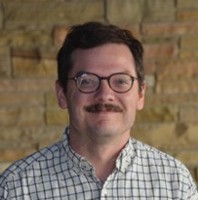 Patrick McCormick
Patrick McCormick received BS degrees in mechanical engineering (2008) and electrical engineering (2013), and a PhD in electrical engineering (2018), all from the University of Kansas, Lawrence. From 2018 to 2021, he served as a Research Electronics Engineer with the Air Force Research Laboratory Sensors Directorate at Wright-Patterson AFB, OH. In 2021, he joined the University of Kansas as an Assistant Professor in the Department of Electrical Engineering and Computer Science. His research interests include radar waveform diversity and design, adaptive signal processing, and radar-communications spectrum sharing. Dr. McCormick has authored numerous refereed journal articles, conference papers, book chapters, and patents. He received the 2018 IEEE AESS Robert T. Hill Best Dissertation Award, the 2023 DARPA Young Faculty Award, and the 2025 Fred Nathanson Memorial Award. He is an Associate Editor for IEEE Transactions on Aerospace and Electronic Systems and a member of the IEEE AESS Radar Systems Panel.
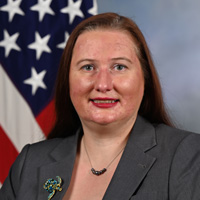 Lynna McGrath
Ms. Lynna McGrath serves as the Deputy Associate Administrator for Spectrum Management within the Office of Spectrum Management (OSM) of the NTIA. In this role, she leads OSM’s engineering and technical analysis efforts, oversees frequency assignments and system certifications, and chairs the Interdepartment Radio Advisory Committee (IRAC). The IRAC assists the NTIA in assigning frequencies to U.S. Government radio stations and in developing and executing policies, programs, procedures, and technical criteria pertaining to the allocation, management, and use of the electromagnetic spectrum. She also leads NTIA’s band study efforts to identify 500 MHz of spectrum for repurposing in accordance with the 2025 Working Families Tax Cut Act. Prior to joining NTIA, Ms. McGrath served as the Director of Spectrum Policy and Planning at NASA, where she led a team managing NASA’s spectrum activities at both domestic and international levels. Prior to NASA, she held civilian and contractor positions at the Department of Defense in the Office of the Chief Information Officer, where she was instrumental in advancing spectrum policies. She led several DoD spectrum repurposing initiatives, including AWS-3 and 3450–3550 MHz, helped establish processes for identifying and resolving spectrum-dependent system capability gaps, and assisted with the preparations for the World Radiocommunication Conference. She also supported the Joint IED Defeat Organization and the Department of Homeland Security and the Department of Energy spectrum management offices. Ms. McGrath holds an MS in Engineering and Public Policy and a dual BS in Electrical and Computer Engineering and Engineering in Public Policy from Carnegie Mellon University.
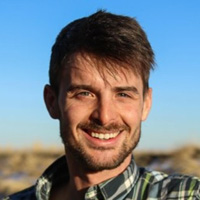 Ryan Montoya
Ryan Montoya received the BS and MS degrees in electrical and computer engineering from the University of Colorado Boulder, in 2017, and plans to defend his PhD in electrical engineering at CU-Boulder on the topic of the use of AI/ML for design and optimization of reconfigurable arrays for 6G systems. He has six years’ experience as a software engineer at LGS Innovations, focusing on the use of AI/ML for software defined radios. He currently works at the University of Colorado’s Center for National Security Initiatives. He is an author of multiple scientific patents and publications, as well as fictional books. His research interests include the application of adjoint variable methods in electro-magnetic optimization and design, the intersection of AI/ML and wireless telecommunications, and metasurface and frequency selective surface design.
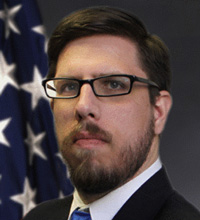 Sean O’Rourke
Sean M. O’Rourke received the BS degree cum laude in electrical engineering, and the MS and PhD degrees in electrical and computer engineering from the University of California, Irvine, in 2008, 2011, and 2018, respectively. He is a research electronics engineer with the Intelligent Perception Branch, DEVCOM Army Research Laboratory (ARL), Adelphi, Maryland, where he was also detailed as a visiting research engineer from 2022 to 2024. Previously, he was with the Air Force Research Laboratory, Sensors Directorate (AFRL) from 2015 until 2024. His research interests include statistical signal processing; multisensor data fusion; target tracking; optimization theory; and machine learning. Dr. O’Rourke was a recipient of the U.S. DoD Science, Mathematics, and Research for Transformation (SMART) Scholarship in 2013. He has received multiple internal ARL, AFRL, and DoD awards for his research. He is also a member of Eta Kappa Nu and Tau Beta Pi.
 Troy “Bucket” Orwan
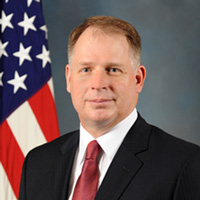
Troy “Bucket” Orwan currently serves as the Spectrum Engineering Branch Chief, within the Office of Spectrum Management (OSM) of the NTIA. He is responsible for directing spectrum engineering efforts supporting practical analyses, technical policy development, interagency collaboration, and strategic planning to enable national spectrum strategies, protect mission-critical federal systems, and aid global U.S. leadership in wireless technology innovation. Prior to coming to NTIA, Mr. Orwan was the Director for Electromagnetic Spectrum (EMS) Operations Policy and Programs at The Corvus Group, LLC, responsible for leading the organization’s spectrum management (SM), electronic warfare (EW), EMS operations (EMSO) and EMS environmental effects (E3) efforts, providing government agencies and commercial industry with focused consulting, strategic planning and technical analysis and assessment services. As a former staff Senior Policy Analyst at the Office of the Secretary of Defense, he possesses extensive expertise and experience in the development and implementation of strategic plans and policy to enable assured access to and unimpeded use of the EMS through efficient and effective EMSO; the advancement of EMS enterprise information technology (IT) modernization efforts; development and fielding of innovative EMS resource/battle management (EMBM) tools/capabilities; and the engagement with federal and non-federal agencies to identify and overcome EMS/EMSO gaps and requirements to fully support national security commitments. Mr. Orwan has 24 years of commissioned service in the U.S. Air Force. An electronic warfare officer and combat parachutist with more than 2,500 hours in the EF-111A and F-15E fighter/electronic combat aircraft, he has led combat operations throughout Bosnia-Herzegovina, Iraq, and Afghanistan. He is an Outstanding Graduate of the Air War College, and holds BA degrees in chemistry and mathematics from Coe College, and an MA degree in statistics from Colorado State University, in Fort Collins. He currently lives with his wife and daughter in Fairfax Station, Virginia.
 Tricia J. Paoletta
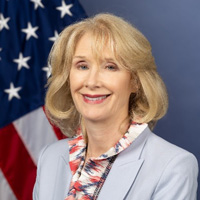
Tricia J. Paoletta joins NTIA as Senior Advisor for Spectrum. Ms. Paoletta most recently was a partner at Harris, Wiltshire & Grannis LLP, where she focused on telecommunications, trade, and technology policy. She has also served as Director of Telecommunications Trade Policy in the Office of the U.S. Trade Representative, Executive Office of the President; Majority Counsel to the House Energy and Commerce Committee; senior advisor to the International Bureau Chief and Office Director at the FCC; and Vice President of Government Relations at a leading digital infrastructure provider.
 Dimitrios Peroulis
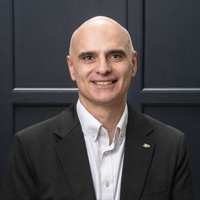
Dimitrios Peroulis is the senior vice president for partnerships and online at Purdue University. In this role, he leads the offices of Industry Partnerships, Global Partnerships, Engagement, and online programs. He is also the Reilly Professor of Electrical and Computer Engineering. Mr. Peroulis’s research interests are focused on the areas of reconfigurable systems, plasma RF electronics and RF-assisted lyophilization. He has been a key contributor in developing high-quality, widely tunable filters and novel filter architectures based on miniaturized high-Q cavity-based resonators. He received the National Science Foundation CAREER Award in 2008. He is an Institute of Electrical and Electronics Engineers (IEEE) Fellow and has co-authored more than 450 journal and conference papers. In 2019, he received the Tatsuo Itoh Award, and in 2014, he received the Outstanding Young Engineer Award from the IEEE Microwave Theory and Technology Society.
 Michele Polese
Michele Polese is a Research Assistant Professor at Northeastern University in Boston, Massachusetts, and the Technical Director of the Institute for Intelligent Networked Systems at Northeastern. He is also the chair for the AI-and-RAN working group of the AI-RAN Alliance and a co-founder at zTouch Networks, Inc. He received his PhD from the Department of Information Engineering of the University of Padova, Italy, in 2020. He then joined Northeastern University as a research scientist and part-time lecturer in 2020. During his doctoral program, he visited New York University, AT&T Labs in Bedminster, New Jersey, and Northeastern University. His research interests are in the end-to-end design and testing of open, programmable, intelligent, and secure next-generation cellular networks, including Open RAN, AI-RAN, and 6G. He is also interested in spectrum sharing, experimental wireless research and open-source software, millimeter-wave and terahertz networks, and the performance evaluation of end-to-end, complex networks. He has contributed to O-RAN technical specifications and submitted responses to multiple FCC and NTIA notice of inquiry and requests for comments, and is a member of the Committee on Radio Frequency Allocations of the American Meteorological Society (2022-2027). He is PI and co-PI in research projects on 6G funded by the NTIA, the O-RAN ALLIANCE, U.S. NSF, OUSD, and MassTechCollaborative, and was awarded with several best paper awards and the 2022 Mario Gerla Award for Research in Computer Science. Michele is an editor for the IEEE Transactions on Mobile Computing, IEEE Communications Magazine, and Computer Networks, and has served as guest editor for a JSAC special issue on Open RAN. He was TPC co-chair of European Wireless 2025, WONS 2024, WiNTECH 2024, and WNS3 2021-2022, among others, and he has organized multiple events (Open6G+AI Workshop, IEEE RitiRAN) around open and programmable networks. Mr. Polese holds multiple patents in the area of Open RAN/cellular networks, and he led the establishment of the Open6G testing center at Northeastern.
 Mark Reudink
Mark Reudink is currently Vice President of Product Development at Battelle, responsible for the commercialization of RavenStar™, a broadband massive MIMO digitally steered radio unit. Mr. Reudink’s role includes analyzing the competitive landscape across industries, products, and companies to uncover new market opportunities. Prior to joining Battelle, he was Head of Technology Strategy at Crown Castle and served on the board of 5G Americas and was the chair of the Small Cell Forum. Prior to joining Crown Castle, Mark held leadership roles in engineering and operations with major service providers and several startups. Mark holds a BS in engineering-physics from Pacific Lutheran University, Tacoma, Washington, and an MS in electrical engineering from Oregon State University. He has been granted 16 patents and has authored numerous technical papers and presentations.
 Aric Sanders
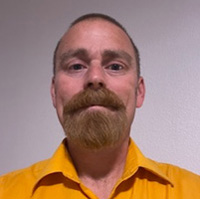
Aric Sanders received his B.S. in physics and mathematics from University of North Texas (1999) and PhD in physics from Yale University (2007). He has been at the National Institute of Standards and Technology since 2006. Currently his research interests are focused on measurements in spectrum research. In particular, in the environmental monitoring of ecosystems such as citizen’s band radio service (CBRS), sensor systems, and intersystem interference metrology.
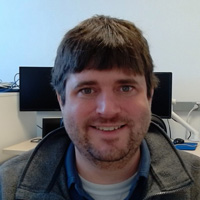 Todd Schumann
Todd Schumann received his BS, MS, and PhD in electrical and computer engineering from the University of Florida in 2019. Since 2019 he has worked for the Institute for Telecommunication Sciences of the National Telecommunications and Information Administration. His focuses include distributed RF sensor networks for advanced spectrum measurements, characterization and interference analysis of embedded devices, and interference to GNSS. Dr. Schumann shared a Department of Commerce 2020 Bronze Medal group award for the four-year development and implementation of the IEEE 802.15.22.3 standard for Spectrum Characterization and Occupancy Sensing (SCOS).
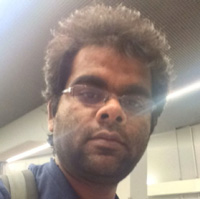 Khemraj “Raj” Shukla
Raj Shukla is an Associate Professor of Applied Mathematics at Brown University in Providence, Rhode Island. Prior to joining Brown, he held research appointments at Hewlett Packard Labs (Colorado), BP America (Texas), and Halliburton (Colorado), and served as a Computational Scientist/Lecturer in Scientific Computing at the University of Chicago. He holds an MA degree in physics from Banaras Hindu University, Varanasi, India. He earned his PhD from Oklahoma State University, completing his dissertation research at Rice University under the supervision of Professor Maarten V. de Hoop and Professor Jesse Chan, with a focus on high-order energy- and entropy-stable numerical methods for linear and nonlinear wave propagation in porous media. His research spans computational mechanics, high-order numerical methods for hyperbolic and elliptic PDEs, and scientific machine learning — with a current emphasis on Physics-Informed Machine Learning (PIML) and neural operator methods.
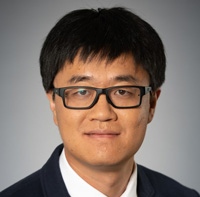 Roy Sun
Roy Sun has been a Principal Architect at CableLabs, in Louisville, Colorado, since 2018. He received a PhD in electrical engineering from the University of South Carolina in 2015. His research interests include spectrum sharing and radio propagation channel measurements and modeling. From 2015 to 2018, he was an Electronics Engineer at NIST, Boulder, CO, developing millimeter-wave channel sounders and conducting channel measurements. From 2007 to 2010, he was a system engineer at T3G Technology, Motorola, and ST-Ericsson, working on 2G and 3G protocols and platforms. He has published 90+ articles, served on 20+ conference Technical Program Committees, and reviewed 200+ manuscripts for academic journals and conferences. He received the 2018 Neil Shepherd Memorial Best Propagation Paper Award from the IEEE Vehicular Technology Society and has received six conference best paper awards. He has been a 3GPP RAN delegate since 2019, focusing on spectrum- and coexistence-related topics.
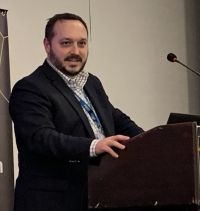 Curtis Watson
Curtis Watson is Chief Scientist for RF AI/ML and Spectrum Applications at The MITRE Corporation, where he leads research at the intersection of radio frequency signal analysis, machine learning, and spectrum data infrastructure. He has over 20 years of experience developing and evaluating AI/ML-based signal processing capabilities and building the research platforms that support them. His sponsor work spans the research laboratories — including AFRL, ARL, and NRL — as well as DARPA, IARPA, and OSW(R&E). Dr. Watson serves as the Principal Investigator for MITRE’s Engineering and Execution Lead in the National Science Foundation National Radio Dynamic Zone (NRDZ) program — a multiyear, multi-institution program focused on spectrum sharing research and experimentation. An important component in that role contributes to the design and development of data infrastructure to collect, standardize, catalog, and share large-scale RF signature datasets generated across distributed testbed environments, including active radio telescope facilities — contributing to the broader community effort to build open, large-scale RF signature resources for researchers and practitioners across government, academia, and industry.
 Adam Wunderlich
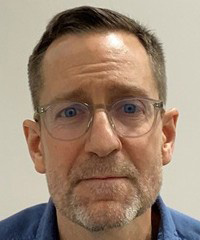
Adam Wunderlich leads the Applied Systems Metrology Group in the Communications Technology Laboratory at the National Institute of Standards and Technology (NIST) in Boulder, Colorado. Since joining NIST in 2015, his research has combined applied statistics, signal processing, and machine learning to advance radio spectrum measurements and electromagnetic interference testing. Dr. Wunderlich has received the NIST Allen V. Astin Measurement Science Award, as well as multiple Department of Commerce medals, including the Gold Medal in 2017 and Bronze Medals in 2020 and 2022.
 Hongwei Zhang
Hongwei Zhang is the Richardson Professor of Electrical and Computer Engineering and Director of the Center for Wireless, Communities and Innovation (WiCI) at Iowa State University. His research focuses on predictable, real-time wireless networking for control, XR, and cyber-physical-human systems in general. He currently leads the ARA PAWR wireless living lab on rural broadband, the ARA OTIC on O-RAN testing and integration, and other agriculture- and AI-focused projects at the WiCI Center.